

Key Takeaways
- Paid summer interns must be classified as W-2 temporary employees rather than 1099 independent contractors because they operate under your direct supervision.
- To legally hire an unpaid intern, your program must pass the strict DOL “Primary Beneficiary Test” proving the student benefits more than your business.
- The Student FICA Exemption does not apply to small businesses, meaning you are required to withhold and match standard Social Security and Medicare taxes.
- The IRS treats nearly all intern compensation, including lump-sum stipends and housing allowances, as taxable income that must be processed through payroll.
- You must use a verifiable timecard system and securely retain all intern tax forms and payroll records for at least four years to protect against audits.
Hiring summer interns could be a win-win for your Lynnwood business. You get extra hands to tackle your mounting to-do list, and a motivated student gets real-world experience.
But before you post that job opening, we need to go over the legal reality. A simple mistake in how you classify or pay your summer help can easily trigger an expensive audit or steep penalties.
Here’s the tax-compliant guide on how to hire an intern for the summer.
What are the different types of internships?
From a tax and payroll perspective, how you classify your summer intern dictates your entire legal and financial responsibility. Mistaking a paid employee for an unpaid volunteer can result in severe Department of Labor (DOL) penalties and back-tax liabilities.
Here’s a breakdown of the different types of internships and how they impact your small business tax obligations.
Paid internships
If you’re compensating an intern for their time, deliverables, or hours worked, they are generally treated as temporary employees.
And because paid interns are employees, you must handle all standard payroll and tax requirements:
- You must have the intern complete a W-4 for tax withholdings and an I-9 to verify employment eligibility on or before their first day.
- You are responsible for withholding Social Security (6.2%) and Medicare (1.45%) taxes from their wages, as well as matching those amounts as the employer.
- You must pay federal and state unemployment taxes on their earnings, just as you would for a regular employee.
- In most states, temporary workers and interns must be covered under your business’s workers’ compensation insurance policy.
Unpaid internships
To determine if your intern can legally go unpaid, the Department of Labor (DOL) uses the Primary Beneficiary Test.
This test evaluates who derives the most value from the relationship. For an internship to be legally unpaid, the intern must be the primary beneficiary, not your business.
To classify an intern as unpaid, your program has to satisfy these core factors:
- The training provided must be similar to what the intern would receive in an educational or classroom environment.
- The internship must primarily benefit the intern’s learning and career development, rather than the immediate operational needs of your company.
- Unpaid interns cannot displace regular, paid employees. Their tasks should complement your existing workforce while giving educational benefits to the intern.
- The length of the internship is strictly limited to the period during which it provides meaningful, active learning for the student.
- There must be a clear, written understanding that there is no promise or guarantee of a permanent job at the conclusion of the internship.
- Both parties must explicitly agree from the very beginning that the intern is not entitled to wages or financial compensation.
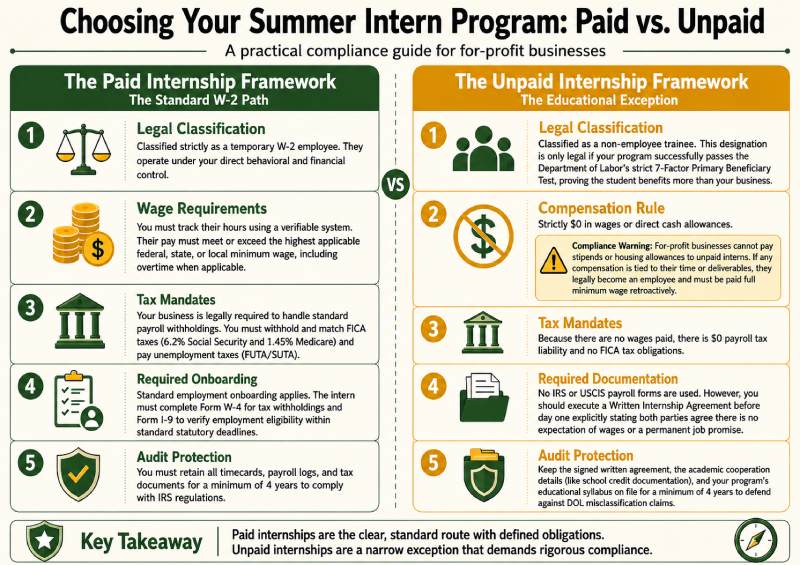
What happens if I misclassify an intern?
If the IRS or the Department of Labor audits your business and finds that an unpaid intern was performing the duties of a regular employee, they will reclassify the intern as an employee.
If this happens…
- You’ll be required to pay the intern back wages matching at least the federal or state minimum wage, plus overtime.
- You’ll owe unpaid FICA and FUTA taxes, plus steep interest and failure-to-deposit penalties to the IRS.
- Violating the Fair Labor Standards Act (FLSA) can expose your small business to lawsuits.
How do I handle payroll for my summer interns?
There are three critical payroll considerations you need to think about when you hire an intern.
1. Employee classification
It’s tempting to classify your interns as 1099 independent contractors because it saves you from paying payroll taxes, but doing so is a massive red flag for tax auditors.
To classify someone as an independent contractor, they must have autonomy over how, when, and where the work is done. Interns naturally fail the 1099 independence test because you retain complete behavioral and financial control over these specifics.
And misclassifying an intern as a 1099 contractor can result in substantial penalties, including paying back taxes for FICA and FUTA, interest charges, and potential legal action from the Department of Labor.
2. Tax withholding requirements
Once your intern is correctly on the payroll as a W-2 employee, you must handle standard federal tax withholdings. This starts with having them complete a Form W-4 and withholding standard FICA taxes from their paycheck, and your business must match those contributions.
You might have heard that students don’t have to pay Social Security and Medicare (FICA) taxes. And this exemption does exist. But the student FICA exemption generally only applies to students who are employed by the school they attend. And they must be enrolled at least half-time during that employment period.
Which means an intern working at your for-profit small business during their summer break does not automatically qualify for a FICA exemption.
3. State, local, and multi-state tax considerations
Just like regular employees, interns are subject to state income tax withholding where applicable, as well as local municipal taxes depending on where the work is physically performed.
And if an intern temporarily relocates to your state for the summer, or if they work remotely from their college apartment in another state, you may trigger multi-state tax obligations. You’ll need to figure out if you’re required to withhold income tax for their home state or the state where your business is located. Or both, depending on reciprocity agreements.
And don’t forget: You’re responsible for contributing to State Unemployment Insurance (SUTA) for the wages paid to your intern. Also, virtually every state requires employers to carry workers’ compensation insurance that covers temporary workers and interns.
How do I pay summer interns?
Whether you want to pay a traditional hourly wage or explore alternative methods like stipends and housing assistance, here is how to structure your intern compensation legally and sustainably.
Setting appropriate wage rates
If you opt for the traditional hourly route (which is often the cleanest for payroll tracking), you need a strategy to set the right rate.
- Your intern’s pay must meet or exceed all federal, state, and local minimum wage requirements. Remember: If your city or state has a higher minimum wage than the federal limit, you’re legally required to pay the higher local rate.
- Look at what other businesses in your industry and geographic area are offering. Paying a competitive rate helps you get candidates who will actually drive value for your business.
- Consider scale-adjusting your compensation based on the intern’s education level and specialized skills.
- Balance fair compensation with your business’s financial limitations. It’s better to hire one well-paid intern for 8 weeks than to overextend your budget on three interns you can’t afford to mentor properly.
Alternative compensation methods
Hourly wages aren’t your only option. Depending on your business model, alternative compensation structures might benefit both your cash flow and the intern’s predictability.
- Fixed stipends: A fixed stipend simplifies payroll processing and gives the intern a highly predictable income. If you go this route, you have to make sure the stipend amount divided by the hours the intern actually works doesn’t accidentally fall below the minimum wage. And it must still be reported on the intern’s W-2, and standard income tax and FICA withholdings apply.
- Project-based compensation: You can structure pay around the completion of specific deliverables (e.g., “Paying $1,500 upon the completion and launch of our new website module”).
- Educational benefits: You can offer to cover the costs of professional certifications, bootcamps, or specialized training courses during the summer. Which can sometimes be tax-free, but only if it qualifies under a formal IRS Section 127 Educational Assistance Program. Otherwise, paying for a student’s personal certifications may count as taxable compensation.
- Housing and relocation assistance: You can offer a housing stipend or cover a few months of local rent. Just note that the IRS considers the Fair Market Value (FMV) of that housing to be a taxable fringe benefit. You’ll need to report this on their W-2, and the intern will owe income tax on the value of that housing.
Keep in mind that the IRS views almost any form of compensation (cash or non-cash) as taxable income.
What records should I keep for summer interns?
When you hire an intern, maintaining meticulous records is your primary defense if the IRS, Department of Labor, or state insurance auditors ever knock on your door.
Plus, they help you evaluate whether the internship program actually provided a return on investment for your business.
To stay compliant, your business should:
- Track every hour worked using a verifiable timecard system.
- Log every dollar paid, and document the fair market value of any non-cash benefits provided.
- Securely store completed Forms W-4, I-9, and state withholding elections for at least four years after the date the tax becomes due or is paid, whichever is later.
- Document each intern’s performance and qualifications if you pay multiple interns differently. Written evaluations prove that wage differences are based on non-discriminatory factors.
Final thoughts
I want launching a summer internship program to be an exciting milestone for your Seattle business, not a source of payroll anxiety!
I can help make compliance easier by helping you properly classify your interns and navigate multi-state tax withholdings, and we can structure legal compensation packages together. Just grab a time on my schedule:
FAQs
“Can I classify a paid summer intern as an Independent Contractor (1099)?”
No. The IRS looks at the level of behavioral and financial control you have over a worker. Because summer interns require close supervision, training, and fixed hours, they almost never qualify as independent contractors. They must be put on payroll as a W-2 employee.
“Can I give my unpaid intern a stipend at the end of the summer?”
If a stipend is tied to hours worked or looks like a substitute for regular wages, the DOL and IRS will view it as regular employment income. If you pay a stipend, it generally must still be run through payroll, or you must ensure it does not inadvertently trigger an employment relationship that violates the unpaid internship rules. Come talk to me about the details before issuing stipends.
“What tax forms does a summer intern need to fill out?”
Before they do any work, a paid intern must complete Form W-4 (for federal income tax withholding) and Form I-9 (to verify their employment eligibility in the United States), alongside any required state tax withholding forms.
“How do you find summer interns?”
The most effective way to find interns is to list your opening on Handshake (the primary digital platform used by college students), post on local university job boards, and partner directly with college career centers.
“What is the best way to hire an intern?”
The best way to hire an intern is to evaluate candidates based on curiosity, soft skills, and adaptability rather than a lengthy resume. Clearly outline a specific project they will own during the summer, and ensure you have a structured W-2 onboarding process ready before their first day.
“How much should you pay a summer intern?”
Small business intern rates typically average between $15 and $24 per hour. Legally, your baseline must meet or exceed local minimum wage laws, but you should scale the rate upward for specialized technical roles or graduate-level students.